
Understanding the Modern Customer Journey
Customer service has evolved significantly over the past five to ten years.
In the past, a customer would call and be placed on hold until an agent picked up to assist.
Today, the support landscape is very different.
Today’s customer can begin their support journey from multiple starting points.
Customers have different channel preferences and expect a smooth and effortless experience across all channels.
The modern customer can begin their support journey from multiple starting points.
Customers have different channel preferences and expect an effortless experience across all channels.
With the advent of self-service capabilities, customers can now begin to help themselves using one of the following methods:
- Power Pages with an interactive bot
- Live chat functionality
- SMS communication
- Interactive kiosks
- Mobile app deployed by the customer’s organization
- Remote screen sharing between a service representative and the customer
- Social media, including Facebook and Twitter
As this list shows, we can never be certain of the customer’s origin.
Therefore, we must be ready, with all possible channels and media open and listening.
Customer Perspective and Expectations
It is not enough to have a multitude of channels.
Your service organization must be integrated, so that:
- All support channels have the same information.
You don’t want the advice given by your bots to be different from that given by a customer service representative. - Your support channels are smoothly connected.
You want information to flow easily from one channel to another.
The complexity doesn’t stop there. In general, a modern service company must take the following elements into account:
Social Media
Customers are very active on social media.
They don’t just comment on what they like — they also strongly express what they don’t like.
And their friends — your potential customers — listen to these comments and form an opinion about your company.
Company Size
Companies often want to target both small customers and large accounts through the same channels.
Support for Customers With or Without a Contract
Everyone receives support, not just those with a Service Level Agreement (SLA).
Again, you don’t know where new customers are coming from.
Fast Response Time
Customers expect quick responses.
If you can’t respond quickly, they’ll go elsewhere — maybe to your competitors, who have a better support channel.
On-Site Support
Sometimes, customers cannot be helped online.
In this case, they often expect the company to come to their site or out into the field to resolve the issue.
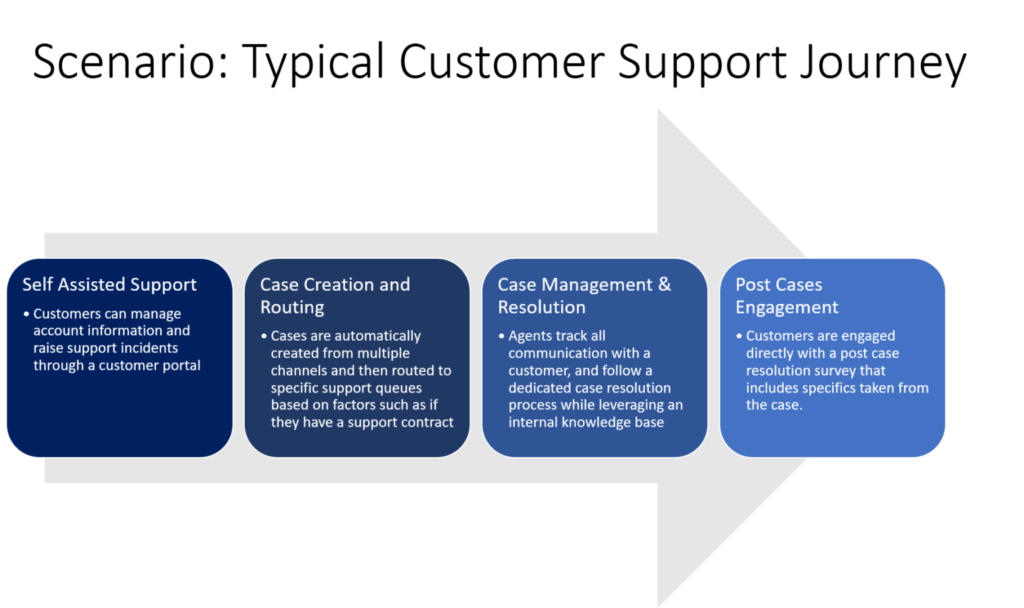
Typical Customer Journey
Customers generally follow a specific path to reach a resolution:
Self-Help
When someone needs help, they start by searching the internet to see if they can solve the problem themselves.
They visit forums, discussion groups, ask questions, hoping for a quick solution.
They may also visit the company’s website and consult the documentation.
Initial Case Creation and Routing
Cases are generated from multiple channels.
They can then be routed to specific queues, based on criteria such as:
- Presence of a contract
- Preferred customer status
- Availability of a qualified technician in a given queue
Case Management and Resolution
A service representative tracks all communications with the customer and applies a dedicated resolution process, using an internal knowledge base.
Communication may occur via email, SMS, or phone call.
Cases are tracked to create a history of interactions.
The knowledge base is enriched so that other representatives can benefit from it.
Post-Case Activities
Customer service organizations are paying more and more attention to what happens after the case is resolved.
These activities are now crucial.
Companies want to gather feedback on the quality of the interaction, to keep channels open and build customer loyalty.
To better understand the case and enrich the knowledge base, they may send a survey to the customer with the case details.
In the modern world, this is generally how customers interact with a support organization within companies.
