
Introduction
Declarative agents extend Microsoft 365 Copilot by allowing you to create assistants optimized for a specific scenario. By defining instructions, you configure the agent’s behavior. By introducing additional knowledge, you enable the agent to reason over information that is not part of its base model. By using skills, you give the agent the ability to interact with external systems, trigger certain behaviors based on system conditions, or use custom workflow logic. One type of skill is actions, which allow a declarative agent to communicate with APIs, both to retrieve and modify data.
Example Scenario
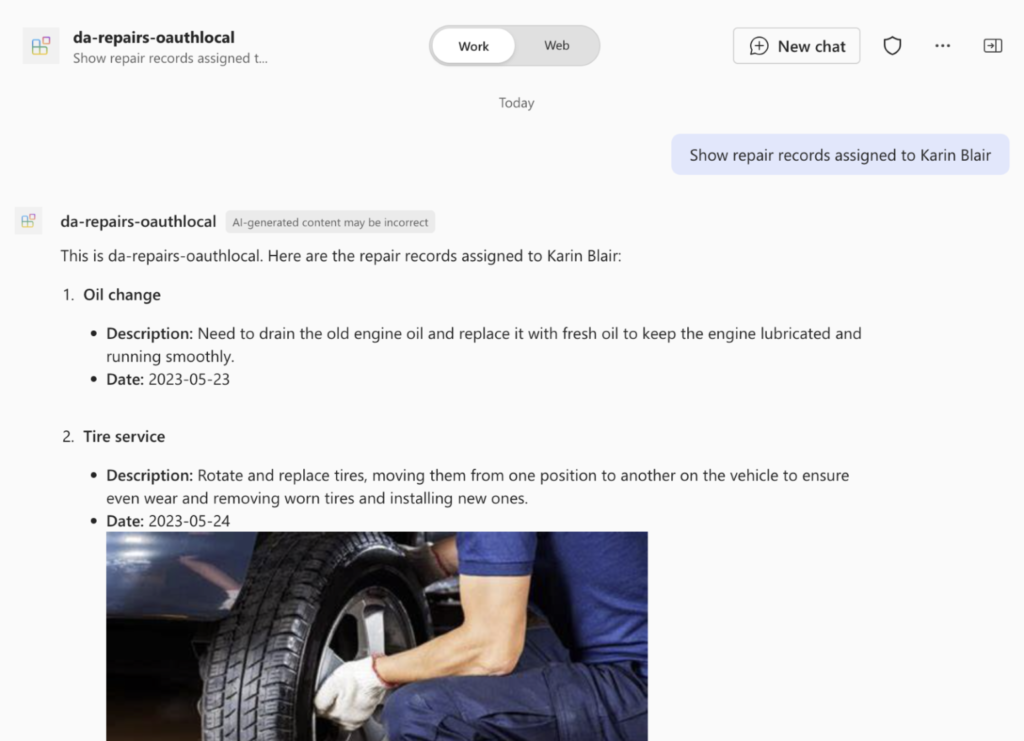
Suppose you work in an auto repair shop. Your organization tracks various repair requests using a specialized system. You and your colleagues regularly consult information about different repairs. The current system offers a rudimentary search feature that only finds repairs matching specific keywords. You would like to have an AI-powered assistant capable of answering questions about repairs asked in natural language. There is an API secured by an API key that exposes repair information, which you could connect to. The information changes regularly, so the assistant should query it in real time.
What Will We Do?
We will analyze the key characteristics of API plugins to help you decide when to use them:
- Custom Actions: What should the agent be able to do? Does it need access to data beyond its base model?
- Data Structure: What is the structure of the data the agent needs to access?
- API Accessibility: Is the API accessible and does it provide the necessary data?
What Is the Main Goal?
By the end of this module, you will understand how API plugins enable declarative agents to communicate with external systems. You will also be able to decide when API plugins are appropriate for extending declarative agents.
