
Identify Business Needs and Define AI Use Cases
You need to prioritize your use cases in order to focus on those that have the greatest impact on the business and are the most cost-effective. Take the following factors into account:
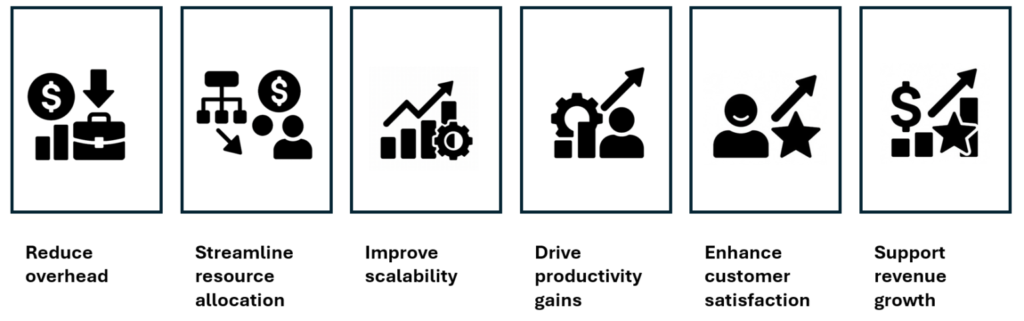
Reduce Overhead
Focus on use cases that minimize manual work, administrative burden, or redundant processes.
For example, you could create a patient intake assistant: an AI agent that interacts with patients through a secure web or mobile interface to collect, validate, and structure information before the patient’s appointment. Before implementing this solution, receptionists manually entered patient information from paper forms into electronic medical records (EMR), which often resulted in duplicates and errors. With the AI agent, patients fill out forms online, the agent clarifies ambiguous answers with additional questions, data is validated in real time through API integrations, and structured data is automatically transferred into the EMR system.
Streamline Resource Allocation
You need to identify use cases that optimize resource efficiency.
Focus on use cases with a clearly defined scope to avoid over-engineering, possibly using multiple modular agents rather than a complex, monolithic agent. Consider use cases that employ lightweight, task-specific models when appropriate, rather than systematically relying on large, generic models, to improve resource efficiency.
For example, you could deploy multiple modular production line optimization agents. In manufacturing, resource efficiency is critical—not only in terms of energy or materials but also in computing and operational costs. Instead of deploying a monolithic AI agent to manage the entire production line, companies increasingly use modular, task-specific agents, each handling a distinct function.
Improve Scalability
Select use cases that enable growth without proportional increases in cost or complexity.
Focus on use cases that can automatically scale on demand and learn and adapt continuously without requiring retraining.
For example, insurance claims processing agents could handle the entire claims workflow—from First Notice of Loss (FNOL) to verification and settlement recommendations—without constant retraining. Agents could adapt through feedback loops and real-time data ingestion to automatically scale during peak demand periods, such as after a natural disaster.
Boost Productivity Gains
Target areas where AI agents can accelerate task execution or improve employee performance.
Consider use cases that automate repetitive tasks and agents that apply intelligent decision-making to enhance efficiency.
For example, AI agents for automated expense management could streamline the entire expense reporting workflow—from receipt capture to compliance verification and reimbursement—without human bottlenecks. Agents would combine automation with intelligent decision-making to eliminate repetitive tasks like manual data entry and receipt matching, apply policy logic to flag anomalies or non-compliant expenses, learn from corrections to improve future accuracy without retraining, and integrate with ERP systems.
Improve Customer Satisfaction
Consider use cases that enhance customer satisfaction. For example, you might choose to improve customer satisfaction by offering faster response times, creating personalized, consistent, and accurate agents available 24/7.
Support Revenue Growth
Consider use cases that enable upselling, cross-selling, or better customer retention.
For example, you could consider agents that use machine learning to proactively identify customers most likely to benefit from an upsell or cross-sell offer. Also consider sales support agents that suggest products frequently purchased together or determine which conditions might encourage an upgrade. Additionally, explore use cases that detect signals that could lead to customer churn, such as decreased product usage or increased support tickets, enabling intervention before the customer is lost.
Examples of Cost-Effective AI Agents
Here are two examples of AI agents—one cost-effective and one not:
IT Support Agent
This AI agent handles common IT issues such as password resets, software installation guides, VPN configuration, and printer troubleshooting.
This agent is cost-effective because it offers:
- Low training cost: Uses pre-trained models fine-tuned on internal documentation.
- 24/7 availability: No need for shift work or overtime pay.
- Quick ROI: Reduces 50% of Level 1 support tickets, decreases wait times, and allows support staff to handle more complex issues.
- Scalability: The chatbot can be adapted to new products, tasks, languages, or markets.
Predictive AI System for Managing Stock Levels
As a small specialty bookstore with 500 titles, you invest in an AI agent to predict future demand and manage stock levels.
This agent is not cost-effective because it has:
- High development and maintenance costs: Custom AI solutions can be expensive to build and require ongoing tuning.
- Oversized for the task: Basic spreadsheet tools or rule-based systems could accomplish the task just as well.
- Low ROI: Complexity does not translate into significant savings or performance gains.
