
Introduction to Dynamics 365 Customer Service
Customer service is a key aspect of an organization’s customer engagement strategy. How your customers perceive you is often directly linked to the service you provide them. As an organization, it is important to discover what your customers expect and understand what they consider good customer service.
Once you better understand what your customers expect, you can more effectively implement a service strategy tailored to their needs.
Microsoft Dynamics 365 Customer Service offers many features that organizations can use to manage the services they provide to their customers.
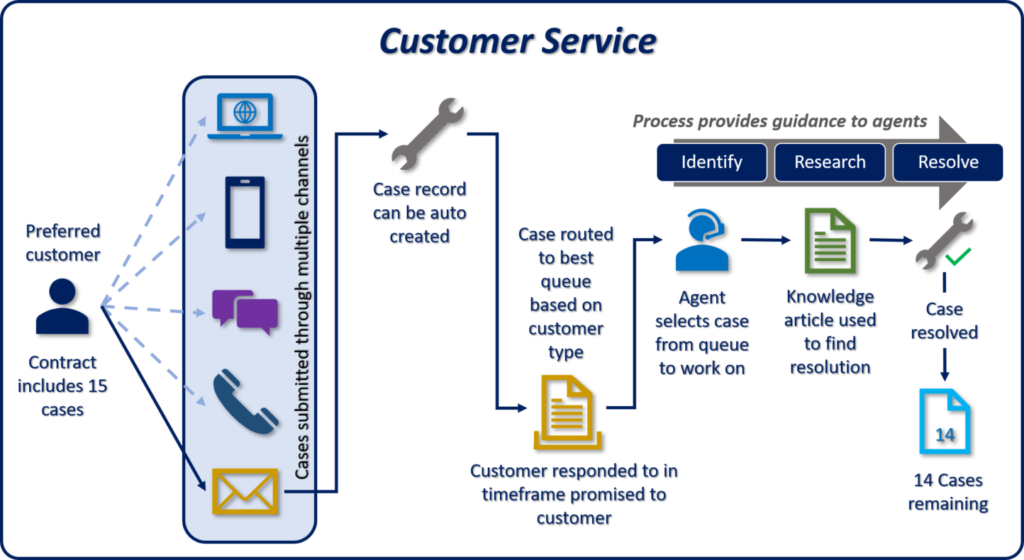
Overview of the Customer Service Landscape
To better understand the context of customer service, let’s look at a few real-world scenarios:
Handling and resolving customer or product-related issues
A customer at a local bike shop discovers that the suspension on their mountain bike is defective and not working properly. They contact the shop to discuss the issue and get help. The issue is created and routed to the organization’s “Mountain Bike Support Request” queue.
Rob, the mountain bike support specialist, receives the issue via Dynamics 365 Customer Service. After speaking with the customer, he schedules a service to repair or replace the defective suspension.
Receiving and responding to customer questions
A customer recently purchased a new table from a furniture store’s website. After receiving it, they try to assemble it but aren’t sure they’re doing it correctly. They contact the company to ask questions and get help.
Sidney, a customer support specialist, receives the customer’s questions. He uses the company’s knowledge base in Dynamics 365 Customer Service to find a FAQ document related to the table. Sidney uses this document to answer Jim’s questions.
Collecting and applying customer feedback
Maria, the product manager for tables and chairs at the furniture company, wants to gather feedback on the home assembly process when customers contact support. She uses the case management feature in Dynamics 365 Customer Service to capture this feedback.
By analyzing case data, Maria can identify which table and chair models cause the most issues during home assembly, and which are easier to put together. She can also determine which instructions should be prioritized for review and improvement.
Proactive support
A customer recently purchased a complete home surveillance system from a regional security company. In addition to cameras, the system includes security, smoke, humidity sensors, and other smart devices.
One evening, a humidity sensor in the customer’s basement is triggered. This generates an alert that automatically creates a support case in Dynamics 365 Customer Service.
Jennifer, a home protection expert, receives the case and initiates an investigation call. The customer reports water in the basement. They discover that the sump pump is no longer working. The customer plugs in their backup pump, and the water is drained before causing damage.
Understanding today’s customer
With all the information and platforms available, customers are more informed than ever. They’re used to getting what they want, when they want it, and how they want it.
Take the typical example of buying a television:
- Before starting, you research new technologies, satisfaction ratings, and top brands online.
- You read customer reviews and choose the model that seems best.
- On the seller’s website, you compare several TVs side by side.
- If you have questions, you use chat to speak with an advisor.
- If you’re still unsure, you go to the store to see and touch the product.
This process applies to many experiences. Customers want to control their journey. They prefer little or no interference, while knowing support is available if needed. They want the freedom to interact at their own pace, with real people on their own terms.
Trends influencing customer service
Many trends influence how customer service is delivered today. As a service organization, it’s essential to understand them to improve the customer experience.
Here are some of these trends:
- Mobile devices
Customers no longer settle for calls or emails. They want to access information portals or chat with an agent from their mobile device. - Social media
Customers easily express their opinions on social media. Issues or complaints must be handled as if they were addressed directly to support. - Self-service
Self-service can take many forms:- A knowledge base to answer common questions
- Self-management of accounts
- Interaction between customers in similar situations
- Internet of Things (IoT)
With more and more connected devices, it’s important to use their technologies to improve service:- Anomaly detection
- Predictive maintenance
- Use of collected data to improve service offerings
- Customer engagement
Engagement isn’t just about collecting feedback. You need to know:- When to engage the customer
- Which channels to use
- What information to collect
